MY-SST APPLET
Overview
The MY-SST applet is where a Malaysian SST-registered company defines its taxable periods, decides which posted documents belong in each period, and produces the SST-02 return for the Royal Malaysian Customs Department (RMCD).
It does four things and nothing else: it maintains tax years (bl_fi_filing_year_hdr) and filing cycles (bl_fi_filing_hdr); it maintains tariff codes (bl_fi_mst_label_hdr under the TARIFF_CODES label list) and tax codes (bl_fi_cfg_tax_code); it files posted generic documents, which copies their taxed lines into a frozen snapshot table (bl_fi_tax_txn); and it reports — three on-screen reports plus the SST-02 itself, which is computed entirely from that snapshot.
The applet does not calculate tax on a transaction. Tax is calculated on the sales, purchase and POS documents from the tax code attached to each line. The applet only decides which of those already-taxed lines land in which return.
Where it fits
| Direction | What | Why |
|---|---|---|
| Upstream | Organization | The company’s SST registration number (bl_fi_mst_comp.sst_registration_id) is printed in Part A of the SST-02. A company with a blank one prints a blank field. |
| Upstream | Tax Configuration | Maintains the same bl_fi_cfg_tax_code rows through a second, differently-behaved screen. See Settings in other applets. |
| Upstream | Doc Item Maintenance | Where a tax code is attached to an item so that documents pick it up automatically. |
| Upstream | Fiscal year configuration (Organization → Company) | A tax year is created against a fiscal year and inherits its start/end month and year. |
| Source of documents | Sales Invoice (Internal), Purchase Invoice (Internal), credit and debit notes, POS documents | Any generic document with a line carrying one of the four SST tax types. |
| Downstream | RMCD | The SST-02 PDF, produced by a JasperReports template on the server. |
| Adjacent | Ledger and Journal, Financial Report | The tax GL balances come from the documents’ journals, not from this applet. Filing writes no journal. |
Screens and menus
Route root: applet/tnt/wavelet/erp/my-sst. Landing route is Tax Year.
| Menu item | Route | What it is |
|---|---|---|
| Tax Year | tax-year | Listing, create, edit of bl_fi_filing_year_hdr — one per company per fiscal year. |
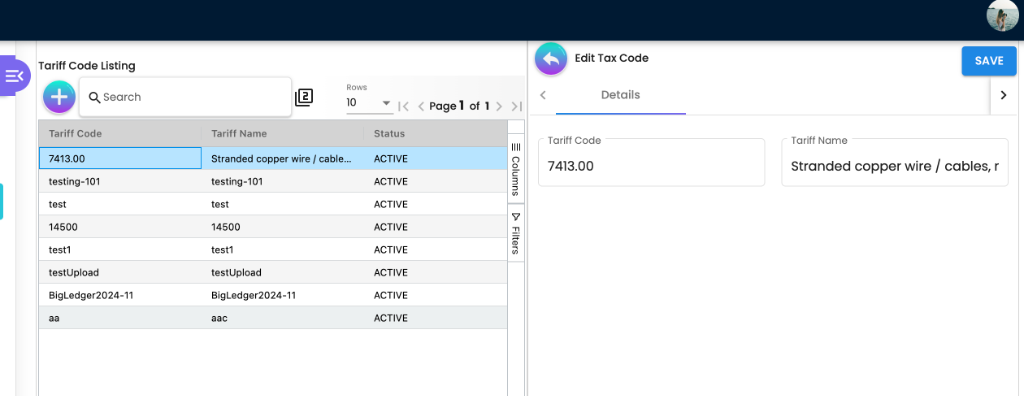
| Tariff Code | label | Listing, create, edit of bl_fi_mst_label_hdr rows in the TARIFF_CODES label list. |
| Tax Code | tax-code | Listing, create, edit of bl_fi_cfg_tax_code. |
| Tax Filing | tax-filing | Listing and create of filing cycles, plus the Tax Filing & Submission workspace. |
| SST Service Tax Report | tax-report | Read-only grid over fi/sst/service/taxable-generic-documents. |
| SST Sales Tax Report | tax-report-sales | Read-only grid over fi/sst/sales/taxable-generic-documents. |
| SST Tax Code Summary | tax-code-summary | Read-only grid over fi/sst/tax-code-summary/backoffice-ep. |
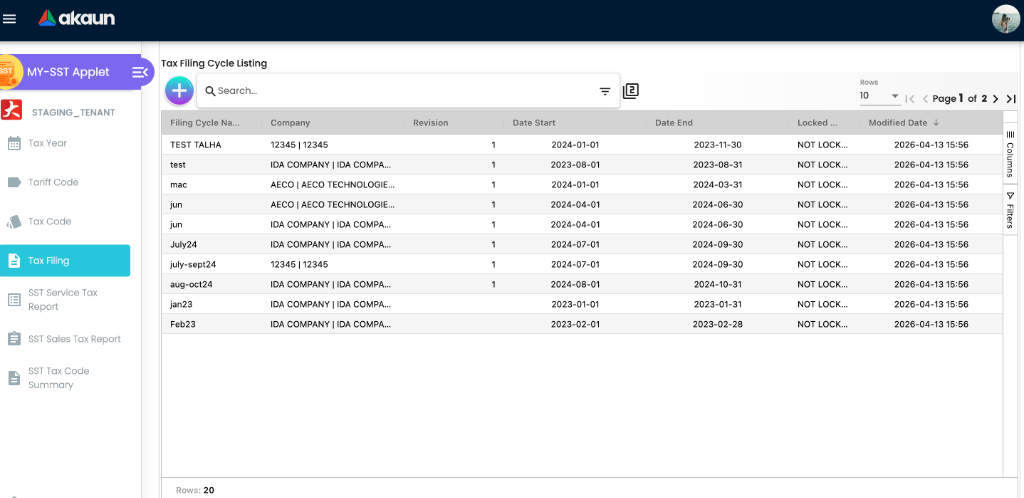
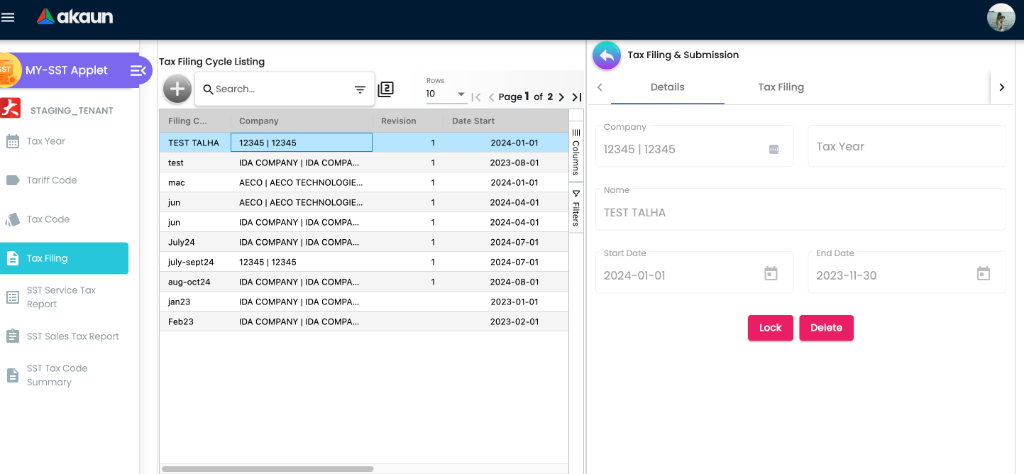
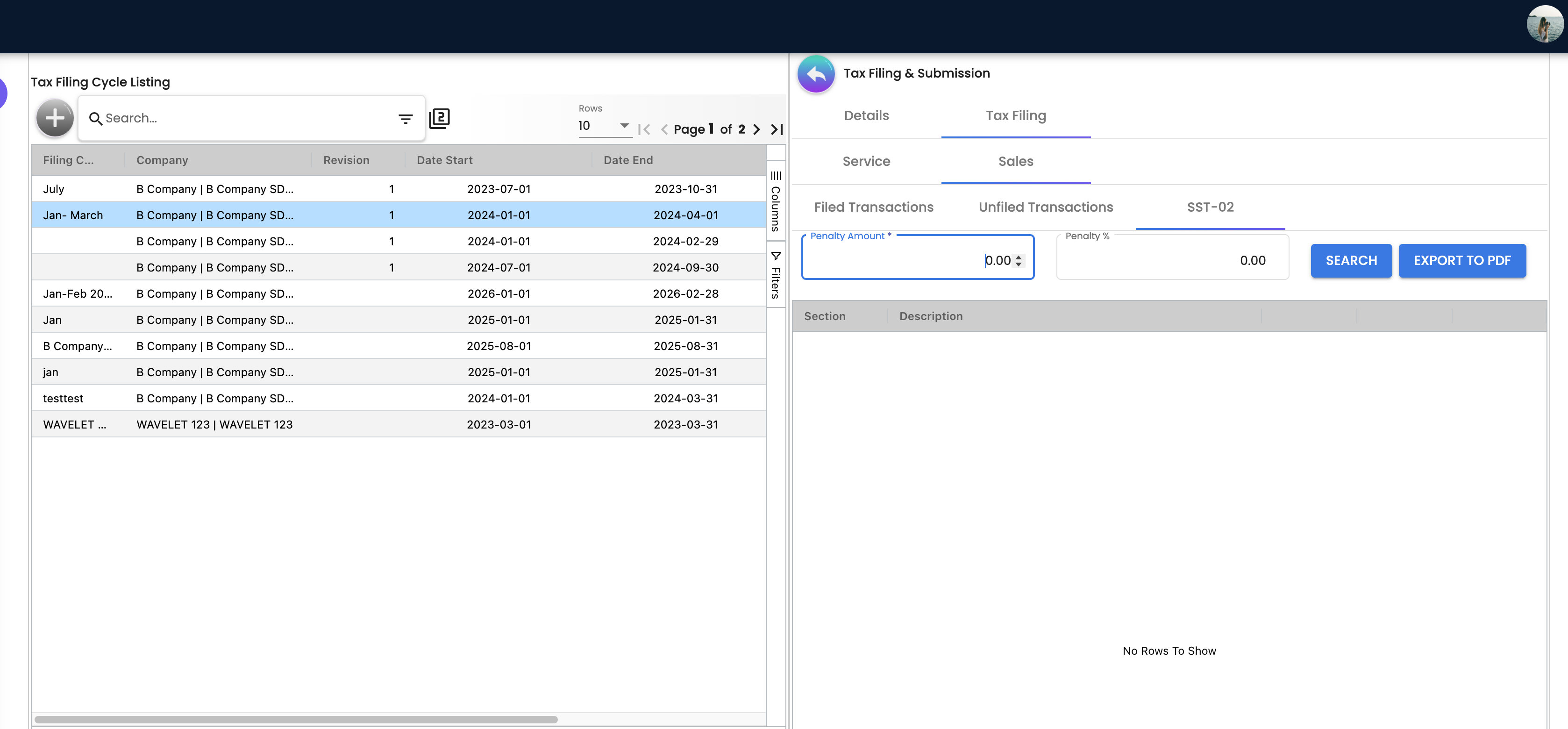
The Tax Filing & Submission workspace
Opening a filing cycle gives a three-level tab structure. The nesting matters, because Service and Sales behave differently at every level below it.
Tax Filing & Submission
├── Details            (cycle metadata + Lock + Delete)
└── Tax Filing
    ├── Service
    │   ├── Filed Transactions
    │   ├── Unfiled Transactions
    │   ├── SST-02
    │   ├── SST-02 Version 2
    │   └── SST-02 Version 3
    └── Sales
        ├── Filed Transactions
        ├── Unfiled Transactions
        └── SST-02
The Service tab carries three SST-02 variants and the Sales tab carries one. The variants are not drafts of each other — each calls a different endpoint with a different hard-coded set of service tax codes (see How each SST-02 box is computed).
Tariff Code screens
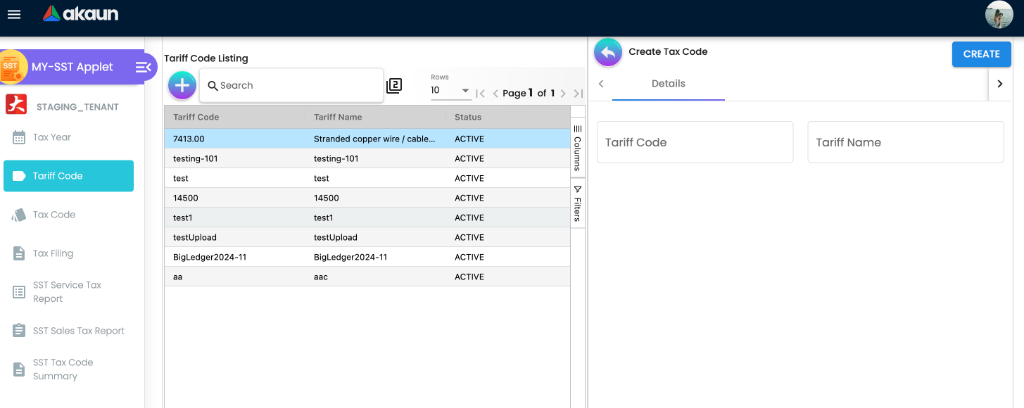
Configuration
Before you can use it
| Prerequisite | Where | Why it blocks you |
|---|---|---|
| Company with an SST registration number | Organization → Company | Part A of the SST-02 reads bl_fi_mst_comp.sst_registration_id. Blank here means blank on the return. |
| Fiscal year on that company | Organization → Company → Fiscal Year | The Tax Year form takes its start/end year and month from the selected fiscal year. Without one the tax year is created with null period bounds. |
The TARIFF_CODES label list | Seeded by the platform | The applet looks the list up by code and never creates it (label.effects.ts, criteria code = 'TARIFF_CODES'). The list is seeded as a system default with a fixed GUID by the V20221019 Liquibase changelog, so it exists in any tenant provisioned since. If the lookup returns nothing, every tariff code you create is saved with a null label list and Part B1 of the SST-02 comes back empty. |
| Tax codes named exactly as the SST-02 expects | This applet, or Tax Configuration | The SST-02 sums by hard-coded tax code literals. A correctly-taxed document whose tax code is not on the list is filed, appears in Part B1, and contributes nothing to Part B2. See the table in How each SST-02 box is computed. |
| Tax codes attached to items or entered on lines | Doc Item Maintenance | A line with no tax_gst_type is invisible to this applet at every stage. |
| Documents at the right posting status | Sales / purchase applets | Service tax only sees documents at posting_status = FINAL and with a settlement or contra. Sales tax sees anything not VOID. |
Applet settings
Applet-local, and none of it works. app.routing.ts imports the applet’s own FieldConfigurationComponent and DefaultSettingsComponent from components/settings-container/, not the shared blg-shared-utilities screen. The submodule is present and pinned at 7f59480, but it is not what the settings routes render (METHOD §29). AppletSettingsModule and AppletPersonalizationModule are both in AppModule.imports, so the screens do render — they simply do not save.
| Screen | Menu entry | Verdict |
|---|---|---|
Settings → Default Tax Settings (settings/default-selection) | Yes | Two controls, Default Branch and Default Location. Both value-change handlers dereference this.appletContainer, which is never assigned — the component declares @Input() appletSettings$ and @Output() save but is routed directly, so neither is bound. The first branch or location you pick throws. SAVE emits to a listener that does not exist. |
Settings → Field Settings (settings/field-settings) | No | The unbound eight-toggle stub (Unit Discount, SST/VAT/GST, WHT, Blanket Order, Segment, G/L Dimension, Profit Center, Project). Empty component class, no formControlName, SAVE has no (click). Identical artefact to Tax Configuration, Fixed Asset, Merchant Admin, Shipping Pricebook and Supplier. Reachable only by typing the URL. |
| Settings → Webhook, Client-Side Permission, Permission Set / User / Team / Role listings | Not in the menu | Shared-utilities screens, routed but not linked. settings with no child redirects to client-side-permission-listing, so that is the first screen a user who clicks the gear sees. |
Personalization → Default Selection (personalization/personal-default-selection) | Yes | Same two controls, same defect, plus the subscription that would load and patch the stored values is commented out. |
| Personalization → Sidebar | No | Shared-utilities screen, routed but not linked. |
Four-proof result: no setting in this applet passes all four proofs through its own screens.
models/applet-settings.model.ts declares 25 keys (INCLUDE_* ×6, DEFAULT_BRANCH, DEFAULT_LOCATION, ENABLE_* ×6, PRINTABLE, 15 ENABLE_CUSTOM_STATUS_*). A plain grep of the whole src/ tree finds a reader for exactly one of them.
| Key | Declared | Rendered | Persisted | Consumed |
|---|---|---|---|---|
DEFAULT_BRANCH | Yes | Yes (both Default Selection screens) | No — the save path throws before it can build the payload | Yes — the three Service SST-02 components read it to pre-fill their Branch field |
DEFAULT_LOCATION | Yes | Yes | No | No reader anywhere |
| Everything else in the model | Yes | No | No | No |
DEFAULT_BRANCH is the interesting row. The SST-02 components read it from SessionSelectors.selectPersonalSettings, which the shared session effect populates from the per-user USER_SETTINGS row on bl_applet_login_subject_link_ext — not from the applet-level APPLET_SETTINGS row that this applet’s Default Selection screens try to write. So the one consumed setting is a personal setting that this applet’s personalization screen cannot save. In practice the Branch field on the SST-02 tabs starts empty.
There is no inline app-applet-settings-toggle gear anywhere in the applet (METHOD §8 checked, zero hits).
Document behaviour settings
Not applicable in the usual sense: this applet creates no generic document, so there is no status flow, no posting toggle, no printable selection and no e-Invoice flag on its own records. The two behaviours that would normally be settings are fixed in the backend:
- Which documents are eligible is fixed by the SQL in
SSTUow(tax type, posting status, settlement) — see Lifecycle and effects. - Which tax codes each SST-02 box sums is fixed by literals in
SSTController— see the table below.
Settings in other applets that control this applet
| Setting | Where it is set | Effect here |
|---|---|---|
sst_registration_id on the company | Organization → Company | Printed in Part A of the SST-02. |
| Fiscal year start/end month and year | Organization → Company → Fiscal Year | Copied onto the tax year at creation and used to seed the first filing cycle’s start date. |
Tax code rows (bl_fi_cfg_tax_code) | This applet and Tax Configuration | Both applets write the same table with different conventions. MY-SST writes tax_country as the alpha-3 code (MYS), stores the rate unrounded as a fraction (rate / 100), and puts the tariff code in the tax_tariff_code column. Tax Configuration writes the country name, rounds the rate to two decimals of the fraction (so 8.5% collapses to a whole percent), and puts the tariff code in property_json. A row created here cannot be opened in Tax Configuration’s edit screen. |
| Item-level tax code | Doc Item Maintenance | Determines tax_gst_type, tax_gst_code, tax_gst_rate and tax_tariff_code on the document line, which are the only things this applet ever looks at. |
Company default OUTPUT_TAX / INPUT_TAX GL links | Organization → Company → default GL codes | Used only by the filing-cycle carry-forward branch of the lock endpoint, which the applet never triggers. See Lock. |
Feature visibility and permissions
Permission families are not what the menu names suggest, and no single “SST” family covers the applet.
| Action | Permission checked | Notes |
|---|---|---|
| SST Service / Sales Tax Report, all SST-02 variants | API_TNT_DM_ERP_SST02_OWNER / _ADMIN / _READ (TntErpPermissions) | The report endpoints additionally build a targeted permission over bl_fi_mst_branch and bl_fi_mst_comp; an unauthorised target yields an empty grid rather than an error. |
| SST Tax Code Summary | API_TNT_DM_ERP_TAX_CODE_SUMMARY_OWNER / _ADMIN / _READ (TntErpPermissionsV2) | Its own family, separate from SST02. |
| File / File All / Unfile | API_TNT_DM_ERP_GEN_DOC_ADMIN / _OWNER / _READ | Generic-document read permission, not a tax permission. Anyone who can read sales and purchase documents can file and unfile them. Unfile additionally needs API_TNT_DM_ERP_FI_TAX_TXN_OWNER / _ADMIN / _READ. |
| Tax year create / read / update / delete | API_TNT_DM_ERP_FI_FILING_YEAR_* | Full CRUD family. |
| Filing cycle create | TNT_API_FINANCIAL_FILING_CREATE, or TNT_LOG_FINANCIAL_FILING_OWNER / _ADMIN | |
| Filing cycle update | TNT_API_FINANCIAL_FILING_UPDATE, or the two LOG families | |
| Filing cycle delete | TNT_API_FINANCIAL_FILING_**READ**, or the two LOG families | There is no delete permission. Read permission is enough to delete a filing cycle. |
| Filing cycle lock | None | FinancialFilingController.lock fetches the filing with the two-argument getByGuid(guid, dbConn) and never calls doesUserHaveAnyPermission. The permission list it builds is passed only to the previous-cycle check, where it decides a display flag. Any authenticated tenant user can lock a cycle. |
Tariff codes and tax codes are written through the generic label and tax-code endpoints and carry those endpoints’ permission families, not an SST family.
No bl_applet_client_side_perm_dfn rows are seeded for this applet, so the Client-Side Permission listing — the screen the settings route redirects to — opens empty.
Fields
Tax Year (bl_fi_filing_year_hdr)
| Field | Meaning | Required | Notes |
|---|---|---|---|
| Company | Company the tax year belongs to | Yes in practice | No Validators.required; the create button does not check. |
| Fiscal Year | Fiscal year to inherit the period bounds from | Yes in practice | Selecting it copies start_year, end_year, start_month, end_month onto the record. Leaving it empty saves nulls. |
| Name | Free-text label shown in the listing and the filing-cycle drop-down | No | |
| Filing Cycle Duration | 1 Monthly, 3 Quarterly, -1 Custom Month, 0 Custom Duration | No | Stored in duration_filing_cycle. For Custom Month the value saved is the number typed into Specify Month, not -1. |
| Specify Month | Number of months per cycle | No | Shown only for Custom Month. |
| Approval No | RMCD approval reference for a non-standard period | No | Shown for Custom Month and Custom Duration. Never sent — onAdd reads this.form.value.approval while the control is named approval_no, so the field is always saved as undefined. |
Tariff Code (bl_fi_mst_label_hdr)
| Field | Meaning | Required | Notes |
|---|---|---|---|
| Tariff Code | The RMCD tariff code | No validator | Saved to code. |
| Tariff Name | Description | No validator | Saved to name. |
txn_type is set to the literal TARIFF_CODES and label_list_guid to the GUID of the TARIFF_CODES label list looked up at screen load.
Tax Code (bl_fi_cfg_tax_code)
| Field | Meaning | Required | Notes |
|---|---|---|---|
| Tax Code | The code the document line will carry | No validator | Saved to tax_code. This is the value the SST-02 matches against its hard-coded lists. |
| Tax Code Description | Free text | No validator | tax_code_descr. |
| Tax Type | One of SST-SLS-INPUT, SST-SLS-OUTPUT, SST-SVC-INPUT, SST-SVC-OUTPUT | Has a required hint | Saved to tax_gst_type. A code whose type is outside these four is invisible to every query in this applet. |
| Tax Type Name | Read-only echo of the type’s label | Marked required on a read-only input | Not persisted as a separate column. |
| Tax Rate (%) | Percentage, e.g. 6.00 | Validators.max(100) only | Stored unrounded as a fraction in both tax_rate_txn and tax_rate_filing. |
| Tariff Codes | Link to a tariff code | No validator | Saved to the tax_tariff_code column. This is what Part B1 of the SST-02 groups by. |
tax_country is set to MYS — the alpha-3 code of the single country the form filters the country list down to. is_input / is_output are derived from whether the type string contains INPUT.
Filing Cycle (bl_fi_filing_hdr)
| Field | Meaning | Required | Notes |
|---|---|---|---|
| Company | Company being filed for | Yes in practice | FK existence is checked by the DCO; nothing checks it is present. |
| Tax Year | Tax year the cycle belongs to | Yes in practice | Saved to filing_year_guid. Selecting it fills Filing Duration and seeds Start Date from the fiscal year’s start month. |
| Name | Free-text label | No | |
| Filing Duration | Read-only echo of the tax year’s duration | — | Display only. |
| Start Date | First day of the taxable period | No validator | |
| End Date | Last day of the taxable period | No validator | Seeded from the tax year’s duration. Changing Start Date afterwards always recomputes End Date as start + 3 months — onDateChange hard-codes add(3, 'months') regardless of whether the tax year is Monthly, Quarterly or Custom. |
fiscal_year_guid is assigned from a form control named fiscal that does not exist on this form, so a filing cycle is always created with a null fiscal year.
The FinancialFilingDataConsistencyObject validates FK existence for company, branch, fiscal year and fiscal period, and the presence of the platform housekeeping columns. It does not validate that the end date is after the start date, and it does not check for overlapping cycles. Two cycles covering the same month are accepted, and the same document can be filed into both.
Lifecycle and effects
This applet writes no journal, creates no generic document, and moves no stock. Its effect on the ledger is nil; its effect on the tax record is bl_fi_tax_txn.
What “Unfiled” means, and why Service and Sales differ
The Unfiled Transactions grid is a live query over bl_fi_generic_doc_hdr. The two tabs use different SQL.
Service (fi/sst/service/taxable-generic-documents) | Sales (fi/sst/sales/taxable-generic-documents) | |
|---|---|---|
| Document status | posting_status = 'FINAL' | posting_status <> 'VOID' — a DRAFT document qualifies |
| Settlement | (arap_stlm_amount + arap_contra) <> 0, plus an INNER JOIN LATERAL onto the AR/AP contra documents | Not considered |
| Line qualifies when | tax_gst_type = 'SST-SVC-OUTPUT' and (tax_gst_rate > 0 or tax_gst_code = 'ESS0') | tax_gst_type IN ('SST-SLS-OUTPUT','SST-SLS-INPUT') and tax_gst_rate > 0 |
| Date range applies to | the contra (settlement) date | the document date |
| “Taxable Amount” column is | SUM(amount_txn) — gross, tax-inclusive | SUM(amount_tax_gst) — the tax itself |
| Deleted lines | excluded (status <> 'DELETED') | not excluded |
The Service side is therefore a payment-basis view: an unpaid service invoice never appears, however final it is, and a service invoice paid in April appears in the April period even if it was raised in February. That is the Malaysian service-tax rule, and it is implemented in SQL rather than as a setting. The Sales side is accrual-basis and does not even require the document to be final.
File and File All
FILE IT posts the selected document GUIDs to fi/tax-txns/file/backoffice-ep/. FILE ALL posts the current filter to fi/tax-txns/service|sales/file-all/backoffice-ep/, which re-runs the eligibility query server-side and files everything it returns.
For each document, TaxTxnService.fileTaxTxn walks bl_fi_generic_doc_line, keeps only lines whose txn_type is PNS (the item / product-and-service line type), and writes one bl_fi_tax_txn row per kept line. Each row is a snapshot: document type, both document numbers, transaction date, header net / tax / txn / withholding amounts, the line’s net, tax and txn amounts multiplied by the line signum, tax code, tax rate, tariff code, currency, item code, description, quantity, and the entity’s name, GUID, customer-or-supplier flag and tax registration number.
Consequences worth knowing:
- Non-
PNSlines never reach the return. A taxed charge or freight line that the document carries as a different line type is taxed on the invoice and absent from the SST-02. - On success the header’s
posting_tax_gstis set toPOSTED; that is the only thing that moves a document from Unfiled to Filed. FILE ITskips documents already atposting_tax_gst = 'POSTED'.FILE ALLdoes not — it files whatever the eligibility query returns.- If the write fails, the controller returns HTTP 200 with an empty list for that document and leaves
posting_tax_gstunset. Nothing is raised to the user.
Unfile
UNFILE IT posts to fi/tax-txns/unfile/backoffice-ep/. For each document the controller builds a criteria of company plus document header GUID, and TaxTxnService.unfileTaxTxn calls deleteTaxTxn on container.stream().findFirst().get() — the first matching row only. It then clears posting_tax_gst to null on the header.
So on a document with more than one taxed line, Unfile hard-deletes one bl_fi_tax_txn row, leaves the rest attached to the filing cycle, and marks the document unfiled. Filing it again adds a second full set of rows. This is the mechanism behind the recurring duplicate-filing reports. Unfile is a delete, not a status change; there is no audit row left behind.
If no matching row exists, .get() on the empty result throws.
Lock
Lock is PUT fi/filings/backoffice-ep/lock/{guid}.
- It calls
checkPreviousCycleIsLocked: any filing cycle for the same company with an earlierdate_startandlocked_status IS NULLblocks the lock. The query does not exclude deleted cycles. The response is HTTP 200 with the bodyPREVIOUS FILING CYCLE IS NOT LOCKED; the applet’s effect recognises this string and shows it as an error toast. - Otherwise it sets
locked_status = 'LOCKED',locked_time,locked_by_subject_guidand saves. - If — and only if — the request body carries a
glcodekey, it then runsFinancialFilingService.carryForward, which posts a journal named SST-02 Auto Transfer, described AUTO CREATED DURING LOCKING OF FILING CYCLE. The applet never sendsglcode:confirmDialogdispatches the lock with{}and the carry-forward dialog is commented out with the note that carry-forward is a GST concept, not an SST one. The branch is reachable only by calling the endpoint directly.
What Lock does not do: it does not stop filing or unfiling. Neither fileTaxTxn, file-all nor unfileTaxTxn reads locked_status. Documents can still be filed into and unfiled from a locked cycle.
What Lock does do, unintentionally: Part A of the SST-02 is queried with locked_status <> 'LOCKED'. Locking a cycle makes its own Part A — company name, SST number, period start and end, due date — come back empty on every subsequent SST-02 render.
There is no unlock action in the applet.
Delete
Deleting a filing cycle first looks for any bl_fi_tax_txn row against it. If one exists the endpoint returns HTTP 200 with FILED_GENERIC_DOC_FOUND and the message Cannot delete this filing cycle: filed documents found. Please unfile all documents first., which the applet surfaces as an error toast. Otherwise the cycle is soft-deleted without firing a webhook.
VOID of a filed document
VoidTaxProcessor is a generic-document queue subscriber (getQueueCode() = "VOID_TAX_PROCESSOR"). When it runs against a document whose posting_journal is POSTED and whose posting_tax_gst is not already VOID, it calls TaxTxnService.reverseTaxTxn, which writes a new bl_fi_tax_txn row with every amount negated and filing_status = VOID, and sets the document’s posting_tax_gst to VOID. It does not delete the original row; the SST-02 nets the two.
Two caveats:
- Nothing in the Java tree enqueues this processor directly. It runs where a tenant’s job template subscribes it to the generic-document queue. Where it is not subscribed, voiding a document leaves its tax transaction in the return.
- If the document was never filed,
reverseTaxTxnthrows No tax transaction found for this generic document!.
How each SST-02 box is computed
Everything below reads bl_fi_tax_txn filtered by status <> 'DELETED', the company, and the filing cycle. Nothing reads the live documents.
| Box | Source | Filter |
|---|---|---|
| Part A (company, SST no., period, due date) | bl_fi_filing_hdr joined to bl_fi_mst_comp | locked_status <> 'LOCKED'. Due date is computed as the last day of the month after date_end. |
| Part B1, item 10 | SUM(doc_line_amount_net) grouped by tax_tariff_code, INNER JOIN to the tariff-code labels | tax_tariff_code IS NOT NULL. A tariff-code GUID with no matching label row drops out of the total. |
| Part B2 §11a / §11a tax (5%, Sales) | SUM(doc_line_amount_net) / SUM(doc_line_amount_tax) | doc_line_tax_code IN ('SRG5','SW-5','SU-5') |
| Part B2 §11b / §11b tax (10%, Sales) | same | doc_line_tax_code IN ('SRG10','SW-10','SU-10') |
| Part B2 §11c / §11c tax (Service) | same | SST-02: ('SRS6','SVU-6','IMS6') · SST-02 Version 2: ('SRS8','SVU-6','IMS6') · SST-02 Version 3: ('SRS6','SRS8','SVU-6','IMS6') |
| Part B2 §12 | Service: the §11c tax. Sales: §11a net + §11b net | The Sales branch adds the taxable amounts, not the tax amounts. |
| Part B2 §13 (all sub-items) | Never assigned — always zero | Credit-note and bad-debt deductions do not reach the form. |
| Part B2 §14 | = §12 | §13 is not subtracted. |
| Part B2 §15 | Penalty Amount and Penalty % as typed on the tab | The percentage is carried to the form but not used in any arithmetic. |
| Part B2 §16 | §14 + Penalty Amount | |
| Part D §18a (Sales) | ('ZREG0','ZRLG0') | |
| Part D §18b1 / b2 / b3 (Sales) | ('ESA') / ('ESB') / ('ESC-A'), ('ESC-B'), ('ESC-C') | |
| Part D §18c (Service) | ('ESS0') | |
| Part E §19 / §20 / §21 (Sales) | ('EPC-A') / ('EPC-B') / ('EPC-C') |
The three Service variants exist because the Malaysian service tax rate changed. Pick the variant whose tax codes match the rate in force for the period you are filing: the original for a 6%-only period, Version 2 for an 8%-only period, Version 3 for a period that straddles the change.
Because the codes are literals in the backend, a tenant whose SST tax codes are not named exactly SRS6, SRS8, SVU-6, IMS6, SRG5, SRG10, SW-5, SW-10, SU-5, SU-10, ESS0, ESA, ESB, ESC-A/B/C, EPC-A/B/C, ZREG0 or ZRLG0 will get a Part B1 that adds up and a Part B2 that is zero. There is no setting to change the mapping.
The three on-screen reports
| Report | Reads | Scope |
|---|---|---|
| SST Service Tax Report | fi/sst/service/taxable-generic-documents — live documents | Company, filing status, period, tax codes. Shows the contra documents and the latest contra date per row. |
| SST Sales Tax Report | fi/sst/sales/taxable-generic-documents — live documents | Same shape, sales rules. |
| SST Tax Code Summary | fi/sst/tax-code-summary/backoffice-ep — live bl_fi_generic_doc_line INNER JOINed to bl_fi_tax_txn on doc_line_guid | Requires Company, Branch and Filing Cycle. Returns two blocks — by branch and by tax code — with output net, output tax, input net, input tax and net tax; the client appends a Total row computed from the by-branch block only. |
The first two read live documents. The SST-02 reads the frozen snapshot. They are different numbers by design, and they diverge permanently as soon as a filed document is edited.
Related applets
- Tax Configuration — the other maintenance surface over
bl_fi_cfg_tax_code, with different write conventions. - Organization — company SST registration number and fiscal years.
- Chart of Account — the GL codes the tax journals hit; not written by this applet.
- Doc Item Maintenance — where a tax code reaches a document line.
- Sales Invoice (Internal), Purchase Invoice (Internal), Sales Credit Note (Internal) — the documents that get filed.
- Ledger and Journal — where the tax GL balance actually lives.
- Financial Report — for reconciling the return against the tax GL accounts.
- MY E-Invoice Admin — a separate LHDN obligation on the same documents; it shares no tables with SST filing.
Troubleshooting
| Symptom | Cause | Fix |
|---|---|---|
| SST-02 item 10 and item 11c do not tally | Item 10 sums every filed line that has a tariff code. Item 11c sums only filed lines whose tax code is one of the three or four literals for the chosen variant. Any line with a tariff code but a different tax code lands in 10 and not in 11c; any line with the right tax code but no tariff code lands in 11c and not in 10. | Align tax codes to the literals in the table above, and make sure every tax code used carries a tariff code. Reported repeatedly across unrelated tenants (customer-repo-e40ac3#7, #16, #17). |
| The SST Report and the SST-02 do not tally | The reports read live document lines; the SST-02 reads the bl_fi_tax_txn snapshot written at filing time. Editing, voiding or re-filing a document after it was filed changes one and not the other. | Unfile and re-file the affected documents, then re-run the SST-02. Reported at customer-repo-d4fc8d#37 and customer-repo-c0c34b#715. |
| Duplicate rows for credit notes and sales returns in the SST-02 | Unfile deletes only the first bl_fi_tax_txn row for a document and then marks the document unfiled, so re-filing adds a second full set of rows. A document with rows against two filing cycles also appears twice in the eligibility grid, because the tax-transaction sub-query groups by document and filing cycle. | Check bl_fi_tax_txn for more than one filing_hdr_guid per document before re-filing. Reported at customer-repo-bb8ea1#244 and #327. |
| A credit note shows as not filed and cannot be filed | Either its lines are not PNS type, or its tax rate is zero (the Sales eligibility query requires tax_gst_rate > 0), or the file call failed and returned 200 with an empty result. | Confirm the credit note’s lines carry an SST tax type with a non-zero rate. Reported at customer-repo-bb8ea1#272. |
| Credit notes never reduce the tax payable on the SST-02 | Part B2 item 13 is never assigned by the report builder — all four sub-items are hard zero — and item 14 is set equal to item 12, so deductions are not subtracted. | Adjust outside the applet. This is a backend gap, not a configuration error. |
| Part B1 is empty although documents are filed | Either the filed lines carry no tariff code, or the tariff-code rows have no label_list_guid because the TARIFF_CODES label list was missing when they were created. | Check that the TARIFF_CODES label list exists, then recreate the tariff codes and re-file. |
| Part A of the SST-02 is blank after locking | Part A excludes filings with locked_status = 'LOCKED'. | Export the PDF before locking. There is no unlock action. |
| Lock is refused with PREVIOUS FILING CYCLE IS NOT LOCKED | An earlier-starting cycle for the same company is still unlocked. Deleted cycles are not excluded from that check. | Lock the earlier cycles first, in date order. |
| A filing cycle cannot be deleted — Cannot delete this filing cycle: filed documents found | At least one bl_fi_tax_txn row still points at the cycle. | Unfile every document first — remembering that Unfile removes one row per call. |
| A service invoice never appears in Unfiled Transactions | Service eligibility requires posting_status = 'FINAL' and a non-zero settlement or contra amount, and the date filter is applied to the settlement date, not the invoice date. | File it in the period in which it was paid. An unpaid service invoice is correctly excluded. |
| A draft sales invoice appears in Unfiled Transactions | The Sales eligibility query only excludes VOID; it does not require FINAL. | Finalise or void the draft before running File All. |
| Taxed freight or charge lines are missing from the return | fileTaxTxn keeps only lines whose txn_type is PNS. | Carry the taxed amount on a PNS line. |
| Default Branch on the SST-02 tab is always empty, and setting it in Settings throws | Both Default Selection screens dereference an unassigned container, and the value the SST-02 reads comes from the per-user USER_SETTINGS row that neither screen writes. | Pick the branch on the tab each time. |
| End Date jumps to three months after you change Start Date on a monthly cycle | The date handler hard-codes a three-month offset. | Set End Date manually after changing Start Date. |
| Approval No is not saved on a custom-duration tax year | The create handler reads a property name that does not match the form control. | Record the RMCD approval reference elsewhere. |
Related documentation
- Financial Accounting module — where SST filing sits in the period-end close.
- Tax Configuration applet — the tax-code reference, including the divergence between the two maintenance screens.
- Organization applet — company SST registration and fiscal-year setup.