E-Invoice Validation Rules & Troubleshooting
Watch this as a presentation — 1 on this page, slides with narration.
An e-invoice fails in one of two ways, and telling them apart is most of the battle. By the end of this page you will be able to read any rejection, know which of your records to fix, and get the document through. Most rejections come down to a single field group, and most fixes take under two minutes once you know where to look.
Meet GadgetSphere
GadgetSphere Sdn Bhd sells across 22 branches, so its customer list runs from walk-in shoppers who give nothing but a phone number, through corporate buyers with a registration number, to tourists paying with a passport. Nearly every rejection GadgetSphere sees comes from that mix being keyed inconsistently at the counter — and the examples below are the ones its finance team works every month.
The two kinds of failure
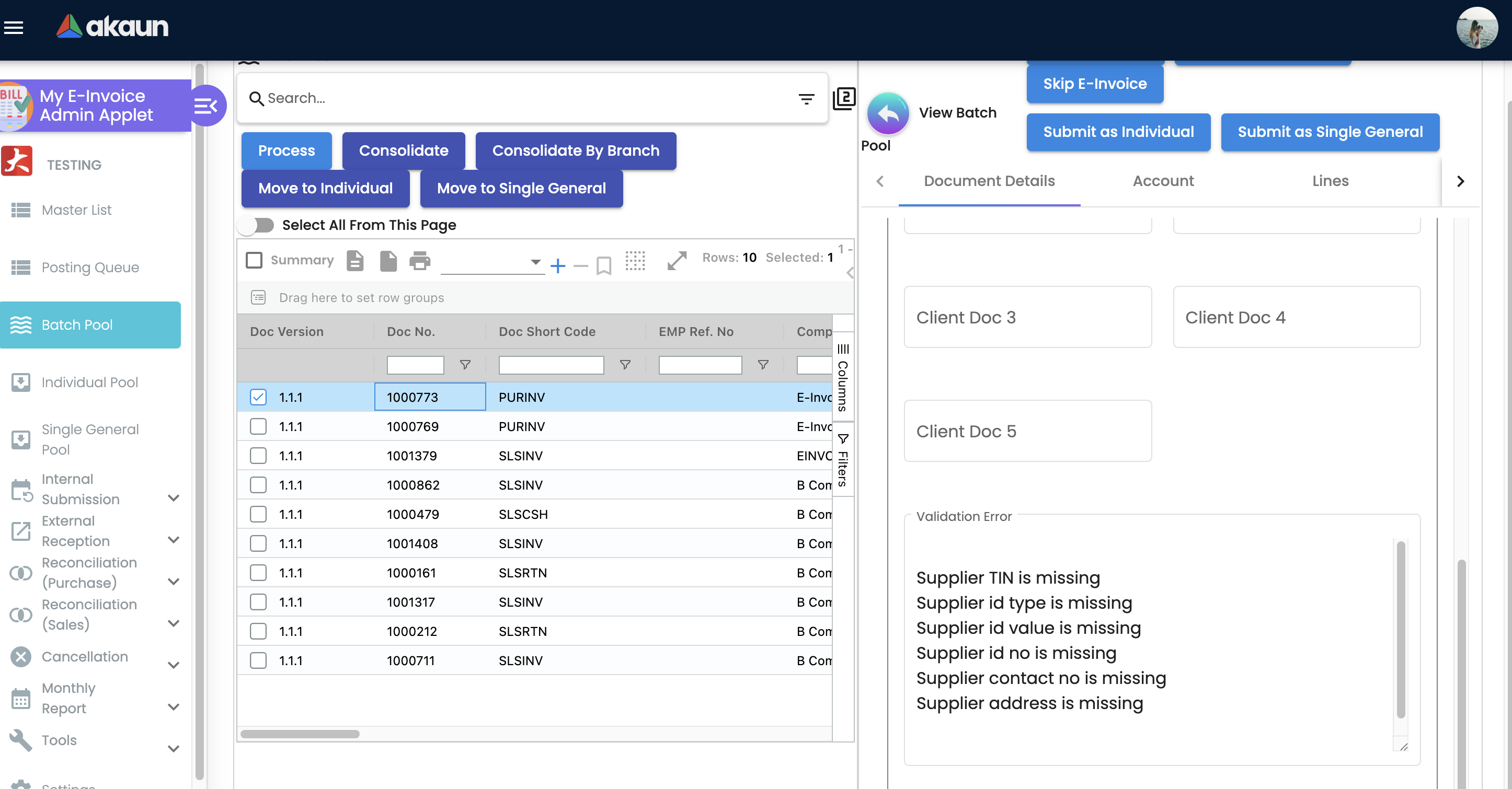
An e-invoice passes two checks, not one — BigLedger’s own completeness check first, LHDN’s content check second. Both produce the same complaint from a distance, “my e-invoice isn’t at LHDN”, and they need completely different fixes. So check the status before you touch anything:
- Held in a pool — a mandatory field was missing, so the document was never sent. Nothing reached LHDN and nothing will until you complete it. Pools & Submission Routing says which pool and why.
- Submitted, then marked Invalid — everything mandatory was there, LHDN accepted the submission and rejected the content. There is an LHDN error code on the record, and that code is what tells you which of your records to correct.
Get the buyer’s identity right — this is where most rejections come from
Every e-invoice carries, for both parties, a tax identification number (TIN) plus an identity document type and its value. That one field group is the largest single cause of rejections in production, by a wide margin. On one large multi-company customer, 426 of 448 recorded rejections were this field group and nothing else.
The rule is short:
- Business registration number (BRN) for a company.
- Passport for an individual who is not Malaysian — never a national identity number.
- National identity number (NRIC) only for a Malaysian individual, and only as 12 digits with no dashes.
- Type it. Don’t paste it.
Read the first two rules together: passport is the rule for a person, not for anyone non-Malaysian. A Singapore or Hong Kong company is not an individual, and it does not take a passport — it takes a business registration number, carrying the number its own home country issued it, alongside the EI00000000030 General TIN for a foreign supplier or EI00000000020 for a foreign buyer.
Those three shapes account for the rejections almost exactly:
- A foreign customer keyed under NRIC instead of Passport. The commonest of all — 322 documents on that one customer. A passport number is not 12 digits, so LHDN rejects it as an invalid national identity number. Fix the identity type on the customer record, not on the e-invoice.
- A national identity number stored with hyphens. 82 documents. On the same customer, 1,803 documents with a clean unhyphenated number passed and not one hyphenated number ever passed. The hyphens alone are enough.
- A business registration number typed into the national-identity field. 20 documents. It is the right number in the wrong box.
The two error codes you will see for this class are CF324 (the identification number is not a valid national identity number) and CF358 (invalid buyer TIN). Both are fixed in the Customer Applet — correct it there and the customer’s next sale is right too.
Mandatory fields
Document header
Every e-invoice needs, at minimum:
- Supplier: name, TIN, identity type + value, industry classification code, business activity description, address, contact number
- Buyer: name, TIN, identity type + value, address, contact number
- Document: e-invoice type and version, issue date/time, currency code
- Amounts: subtotal, total excluding tax, total including tax
Line items
Each line needs an item classification code (LHDN’s list of around 45 codes — leave it blank and BigLedger defaults it to 022 – Others), an item name, a unit price, a tax type code and a tax amount. Only the item name has to be there: the other four are filled in for you before anything checks — a missing price or tax amount becomes zero, and the tax type code is worked out from the tax amount rather than read from the item.
If the line has no tax, the tax type is set to 06 – Not Applicable automatically; if tax is present but no tax type was given, it defaults to 01 – Sales Tax.
004 is reserved for consolidated e-invoices. Never use it on an individual e-invoice line — LHDN marks the document Invalid even when everything else, including the buyer’s TIN, is correct.Addresses
Both the supplier and the buyer address must carry an address line 1 (up to 150 characters), a city (up to 50) and a state. Address lines 2 and 3 (150 characters each) and a 5-character postal code are optional. Anything longer than the limit is shortened silently rather than rejected.
If address line 1, city or state is missing, the document is not submitted at all — it goes to a pool for you to complete.
Which record does BigLedger actually send?
Before you go correcting a customer record, make sure it is the record the e-invoice was built from. There are two places the other party’s details can live — the customer or supplier record, and an e-invoice block typed directly onto the sales or purchase document — and the document wins.
| What is on the document | Whose details go on the e-invoice |
|---|---|
| E-invoice buyer details (on a sale) or supplier details (on a purchase) typed onto the document | Those, exactly as typed. The customer or supplier record is never read |
| That block empty, but the document’s general e-invoice counterparty block filled in | The general block on the document |
| Both blocks empty | The linked customer or supplier record, read fresh at submission time |
Which address
If your customer has several addresses on file: BigLedger sends the first address flagged as the e-invoice address, looking in this order: shipping, then billing, then main. Flag exactly one and the guesswork disappears. If the buyer’s details were typed straight onto the sales document rather than pulled from the customer record, that typed address is used exactly as entered.
Malaysian state codes
LHDN wants the state as a numeric code, not free text. BigLedger resolves what your staff typed automatically: first an exact match on the official state name, then a match after stripping punctuation, then a partial match in either direction (so “Kuala Lumpur” finds “Wilayah Persekutuan Kuala Lumpur”), and finally a list of common abbreviations.
| Code | State | Code | State |
|---|---|---|---|
| 01 | Johor | 09 | Perlis |
| 02 | Kedah | 10 | Selangor |
| 03 | Kelantan | 11 | Terengganu |
| 04 | Melaka | 12 | Sabah |
| 05 | Negeri Sembilan | 13 | Sarawak |
| 06 | Pahang | 14 | W.P. Kuala Lumpur |
| 07 | Pulau Pinang | 15 | W.P. Labuan |
| 08 | Perak | 16 | W.P. Putrajaya |
The abbreviations that resolve on their own, so you do not need to re-key them: KL, WP Kuala Lumpur, WPKL → 14 · Labuan, WP Labuan → 15 · Putrajaya, WP Putrajaya → 16 · Penang, Pinang, P. Pinang → 07 · NS, N9, N. Sembilan, Seremban → 05 · Malacca, Melacca → 04 · Trengganu, Terenganu → 11 · Johore → 01 · Selangor Darul Ehsan, Sel, S.Gor, Sgor → 10.
If none of those match, the state code is left empty and the document waits for you to key a real state. There is no “not applicable” fallback: LHDN rejects state code 17 outright with error CV317, for Malaysian and foreign addresses alike.
For foreign addresses the state passes through as text (or as the country code when the state is blank), and the country defaults to Malaysia if your address data does not say otherwise.
General TINs — when you don’t have the buyer’s TIN
LHDN publishes four General TINs for cases where a real one is not available:
| General TIN | Use for |
|---|---|
EI00000000010 | General public / local buyers (mainly consolidated e-invoices) |
EI00000000020 | Foreign buyers |
EI00000000030 | Foreign suppliers (self-billed purchases) |
EI00000000040 | Government / armed forces |
Rules that trip people up:
- For individual e-invoices, always prefer the buyer’s real TIN.
EI00000000010can be used on an individual e-invoice for a local buyer without a TIN — but only together with identity type NRIC and a valid 12-digit national identity number. Any other combination is rejected.- If the buyer’s identity type is a registration number, the General Public TIN is not acceptable — obtain the company’s real TIN, or, for a local buyer under RM 10,000, let the sale be consolidated instead.
- If the buyer’s identity type is a passport, neither escape is open. The General Public TIN is rejected with a passport, BigLedger only ever substitutes
EI00000000010and only when the identity type isNRIC, and a consolidated e-invoice cannot carry a foreign buyer — so a passport holder with no TIN on the document is not submitted at all and waits in the Individual Pool. Ask for the tax number while the customer is still with you.EI00000000020is LHDN’s General TIN for foreign buyers, and if it is used it has to be keyed onto the document by hand; BigLedger never fills it in for you. - The government TIN is not a general-purpose stand-in either. Using it on an ordinary individual e-invoice gets the document returned Invalid.
- If a buyer has a TIN but no identity value, BigLedger fills the value with
000000000000automatically, which LHDN accepts.
Common validation errors and fixes
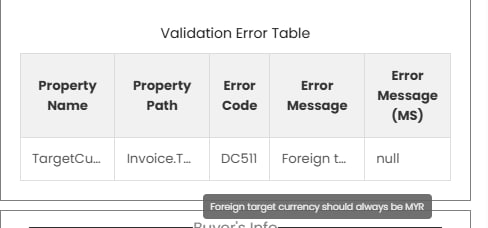
1. Wrong currency setup on foreign-currency invoices
Symptom: A US dollar (or other foreign-currency) invoice is rejected with a currency error.
Cause: On a foreign-currency document the document currency should be the foreign currency and the base currency must be MYR. The error appears when both are set to the foreign currency.
Fix: Correct the base currency to MYR on the source document, then reprocess the e-invoice.
Example: GadgetSphere invoices a Singapore distributor USD 4,800. Keyed with document currency USD, base currency MYR and the exchange rate recorded, it submits cleanly. Keyed with base currency USD by mistake, LHDN rejects it with error DC511.
2. General TIN misuse
Symptom: LHDN marks the document Invalid with a TIN-related message such as “Only General TIN (010)…”, shown against the buyer TIN field in the validation error panel.
Cause and fix: one of the six rules in General TINs above was broken — most often EI00000000010 used with an identity type other than NRIC, or with an invalid national identity number. Correct the buyer’s TIN and identity combination and use Save and Resubmit.
Watch for the second half of this one: even with a correct buyer TIN, a line carrying classification 004 makes an individual e-invoice Invalid, because 004 means “consolidated”. Fix the classification on the line as well.
3. Credit or debit note references an original that is no longer valid
Symptom: A credit note, debit note, refund note or sales return is rejected even though its own data looks correct.
Cause: These documents reference the original e-invoice. If the original was first rejected as Invalid and then resubmitted successfully, it received a new LHDN reference — and your note may still be pointing at the dead one.
There are two error codes here, and they mean different things:
DR303— the referenced e-invoice’s status is not one that can be referenced.DR308— the buyer on your note is not the same buyer as on the referenced e-invoice. Getting the reference number right is not enough; the identity has to match too.
Fix: either update the note’s reference to the currently valid e-invoice and Save and Resubmit, or clear both reference fields and submit the note without a reference. Full walkthrough in Cancelling and Correcting a Validated E-Invoice.
4. The same sale looks like it is at LHDN twice
Before you act on this, work out whether the duplicate is real or apparent. Acting on an apparent one destroys valid e-invoices.
Apparent duplicate — the same number, two different documents. Sales invoices and self-billed purchase invoices draw their document numbers from two independent sequences that both start at the same value, so the same number legitimately exists twice: once on a sale, once on a purchase. The submission listing does not show which direction a document went, so the two rows look like one document submitted twice.
Real duplicate — one sale inside two Valid e-invoices. This does happen: for example, a receipt submitted individually while a copy of it was still waiting in the Batch Pool, so the monthly consolidation reported it a second time; or a manual push to the Batch Pool performed twice. LHDN’s records then overstate your sales.
How you find it: by reconciling, not by reading Submission History. See The Month-End E-Invoice Cycle.
How you fix it: inside 72 hours of validation, cancel the e-invoice that carries the duplicate and re-report the legitimate documents. Past 72 hours, issue a credit note for the duplicated amount and involve your accountant — usually your ledger is right and only the LHDN reporting is overstated. Both routes are in Cancelling and Correcting a Validated E-Invoice.
5. Backdated documents rejected for their issue date
Symptom: A document dated in the past is rejected because of its date and time.
Cause: LHDN requires the e-invoice issue date-time to be the actual submission time, not the original transaction date. The transaction date is preserved separately on the document, so you lose nothing.
Fix: nothing to do by hand — BigLedger stamps the submission time automatically. If you see this on documents from an external integration, check that the integration is not overriding the issue date-time with the historical transaction date. To consolidate backdated B2C receipts from earlier months, see Pools & Submission Routing.
The fix loop
Whatever the error, the recovery is the same four moves:
- Find the document. In a pool (never submitted) or in Internal Submission → To IRB E-Invoice (submitted and Invalid). The LHDN error code and message are shown on the record.
- Fix it at the source. Buyer identity and address belong on the customer record; currency and lines belong on the sales document. Fixing only the e-invoice leaves the same error waiting for the next sale.
- Save and Resubmit.
- Watch it to Valid. Not to “Submitted” — that only means LHDN is still deciding.
What success looks like
Thirty seconds, one screen. Open My E-Invoice Admin Applet → Internal Submission → To IRB E-Invoice, filter to the document you just fixed, and check that:
- Its status reads Valid — not Submitted, not IN_QUEUE, not Invalid.
- The customer record you corrected now shows the right identity type and a clean tax number, so the next sale to that customer submits first time.
Common mistakes
| Mistake | What you see | Fix |
|---|---|---|
| Fixing the e-invoice but not the customer record | The same rejection returns on that customer’s next sale | Correct identity, tax number and address in the Customer Applet, then resubmit |
| Pasting a tax number from a browser or PDF | A field that looks perfect and is rejected every time | Delete the field and retype the digits by hand |
| Keying a foreign customer as NRIC | CF324 — invalid national identity number | Identity type Passport for an individual who is not Malaysian; a foreign company still takes its business registration number |
| Storing a national identity number with dashes | CF324 again, on a number that looks correct | 12 digits, no separators |
| Cancelling on the strength of repeated document numbers | Valid e-invoices destroyed for no reason | Check the document type first — sales and self-billed purchase numbers can collide |