Core Concepts
Understanding core claims concepts is essential before establishing expense policies or configuring approval matrices. These concepts explain how employee expenses are validated against corporate policies and how approved reimbursements post to financial ledgers.
The Employee Claim Processing Lifecycle
Expense reimbursements follow a structured 5-step lifecycle. Each step represents a policy verification milestone and financial authorization.
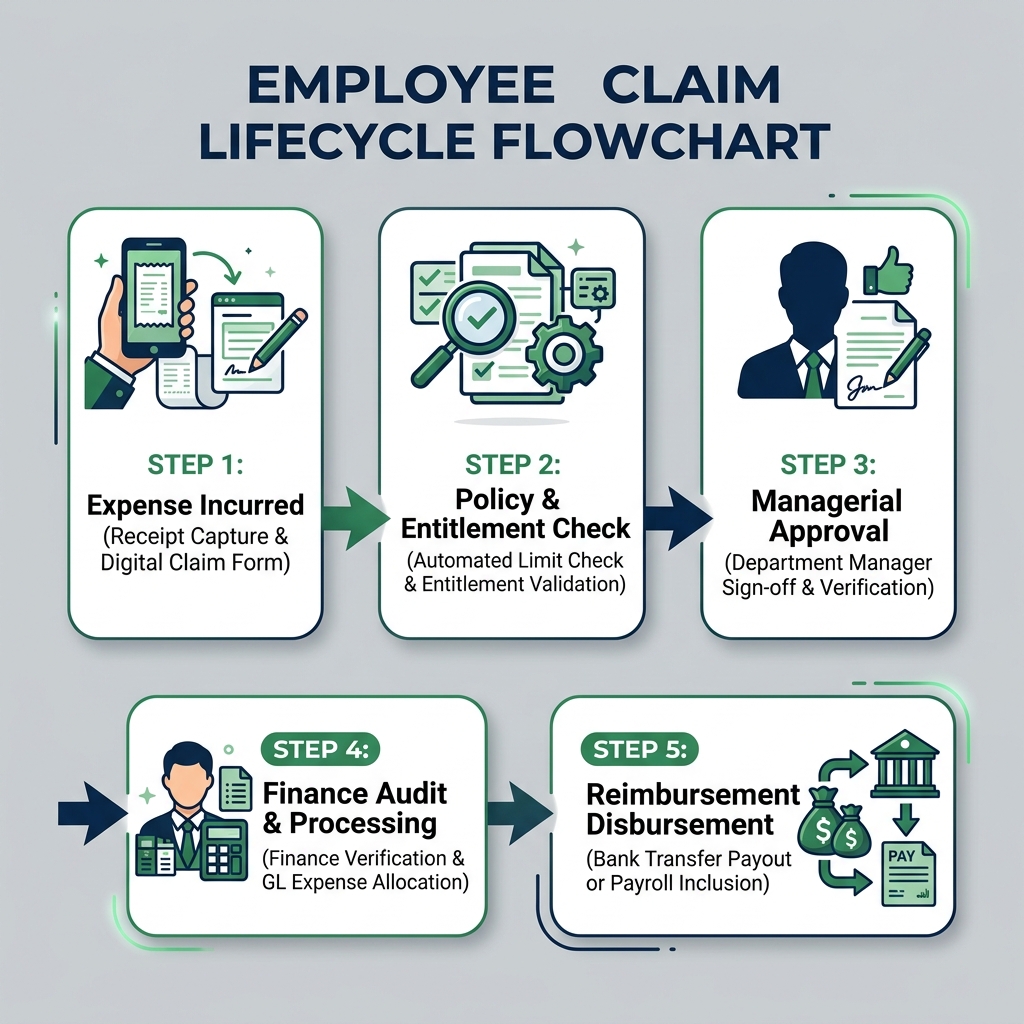
| Step | Milestone | Business Purpose | Applet Used |
|---|---|---|---|
| 1 | Expense Incurred | Employee incurs out-of-pocket business expense and scans paper receipt | Claim Applet |
| 2 | Policy & Entitlement Check | System checks claim against employee grade limits and annual balance caps | Claim Applet |
| 3 | Managerial Approval | Department manager reviews receipt and business justification | Claim Applet |
| 4 | Finance Audit & Processing | Finance verifies tax deductibility, checks GL coding, and approves payout | Claim Applet / Claim Cycle Applet |
| 5 | Reimbursement Disbursement | Funds transferred to employee bank account or included in monthly payroll | Accounts Payable / Payroll Integration |
Tax Deductibility & Entertainment Claim Rules
Tax authorities enforce strict rules regarding business entertainment expenses. BigLedger automatically segregates entertainment claims into tax-deductible vs. non-deductible GL accounts:
- 100% Tax Deductible: Employee welfare meals, annual staff dinners, client meals directly tied to contract negotiations.
- 50% Tax Deductible: General client entertainment and promotional corporate hospitality.
What to Read Next
- Configuration — Set up expense categories, employee grade entitlement caps, and approval matrices.
- Use Cases — Review reference architectures for corporate travel, medical benefits, and sales mileage.