Core Concepts
Understanding core procurement concepts is essential before configuring vendor pricebooks or processing supplier invoices. These concepts explain how procurement documents flow through the ERP and how warehouse receipts impact financial ledgers.
The Procurement-to-Pay (P2P) Document Lifecycle
Procurement transactions follow a structured 5-step lifecycle. Each step represents a distinct legal commitment, inventory movement, and financial milestone.
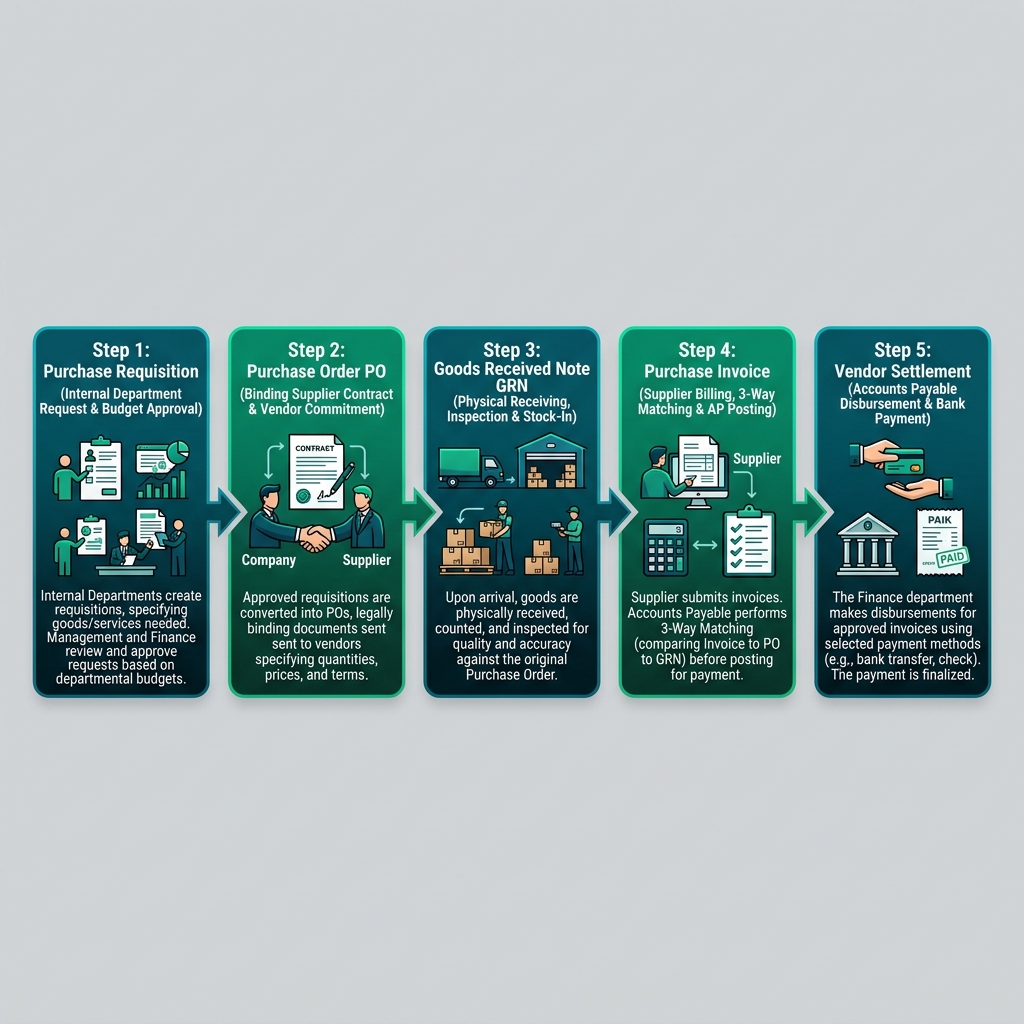
| Step | Document | Business Purpose | Inventory Impact | Accounting Impact |
|---|---|---|---|---|
| 1 | Purchase Requisition | Internal department request asking procurement to buy goods | None | None |
| 2 | Purchase Order (PO) | Legally binding contract sent to vendor specifying items & prices | Stock Expected (Incoming PO quantity) | None (Commitment recorded) |
| 3 | Goods Received Note (GRN) | Receiving slip issued upon physical arrival of goods | Stock Increased (Physical stock-in) | GRNI Accrual (Debit Inventory / Credit GRNI) |
| 4 | Purchase Invoice | Supplier’s commercial billing document demanding payment | None (if GRN already executed) | Accounts Payable Credited, GRNI Cleared |
| 5 | Vendor Settlement | AP cash disbursement or bank transfer payment | None | Bank Credited, Accounts Payable Debited |
3-Way Invoice Matching Mechanics
To prevent unauthorized payments and billing errors, BigLedger enforces 3-Way Invoice Matching before an Accounts Payable invoice can be approved for payment disbursement:
          ┌─────────────────────────────────────────────────────────┐
          │                  Purchase Order (PO)                    │
          │             (Approved Quantities & Prices)              │
          └────────────────────────────┬────────────────────────────┘
                                       │
                ┌──────────────────────┴──────────────────────┐
                ▼                                             ▼
┌───────────────────────────────┐             ┌───────────────────────────────┐
│     Goods Received Note (GRN) │             │       Supplier Invoice        │
│    (Physical Stock Received)  │<───────────>│    (Vendor Billing Demand)    │
└───────────────────────────────┘ 3-Way Match└───────────────────────────────┘- PO vs. GRN: Verifies that the warehouse physically received the exact quantities ordered.
- PO vs. Invoice: Verifies that the supplier billed the exact unit prices agreed upon in the purchase order.
- GRN vs. Invoice: Verifies that the invoice only bills for items actually delivered to the warehouse.
Understanding GRNI (Goods Received Not Invoiced)
When goods arrive at the warehouse, inventory balance increases immediately via the Goods Received Note (GRN). However, the supplier’s formal invoice may not arrive until weeks later.
To maintain accurate financial statements, BigLedger uses a clearing account called Goods Received Not Invoiced (GRNI):
- Upon GRN Execution: Debit Inventory Asset, Credit GRNI Liability Clearing Account.
- Upon Invoice Receipt: Debit GRNI Liability Clearing Account, Credit Accounts Payable.
This ensures your balance sheet reflects inventory asset value immediately upon physical receipt without waiting for vendor invoices.
What to Read Next
- Configuration — Set up vendor pricebooks, requisition approval hierarchies, and receiving rules.
- Use Cases — Review reference architectures for raw material procurement, trading stock reordering, and consignment purchases.